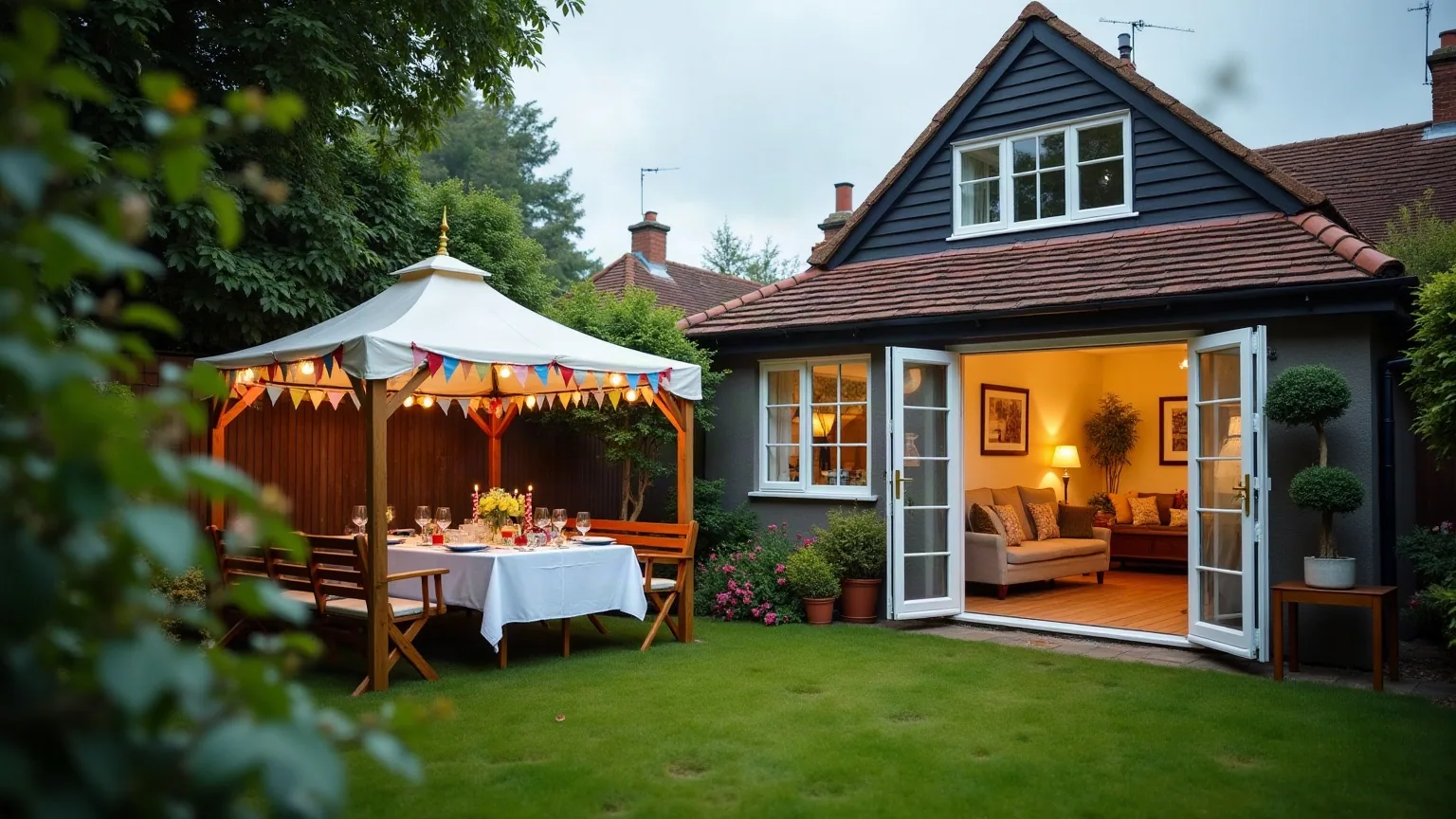
Quick answer: For a garden party, make a provisional weather call 24 hours before, a final venue call three hours before, and an immediate safety decision if conditions deteriorate. Ordinary light rain is often manageable with a sensible sheltered setup. Thunder, unsafe wind, flooding or an unstable temporary structure are not conditions to wait out outdoors. Everyone should move to a safe enclosed building or hard-topped vehicle during lightning; tents and gazebos are not lightning shelters.
This guide focuses on home parties, birthdays and small garden gatherings. Larger public events need a formal event plan, qualified suppliers and venue-specific safety measures.
Decide the backup before you book or invite
First, be honest about which of these three backup choices is genuinely workable:
| Backup | Use it when | Check before promising it |
|---|---|---|
| Move indoors at the same address | A living room, kitchen/diner or hall can hold the guests safely | Seating, clear exits, accessible access, noise and indoor food service |
| Switch to a hired indoor venue | Home cannot fit the group and an alternative venue is available | Written booking terms, opening access, budget and guest travel |
| Postpone, shorten or cancel | No safe backup has sufficient capacity, or travel/conditions are unsuitable | Supplier terms, refunds, and a reliable way to reach everyone |
A small room that physically holds 25 people is rarely a workable alternative for a 25-person sit-down meal. Factor in the space taken by tables, chairs, food service and coats or bags, and leave people enough room to move. Use the party-room capacity guide to check your layout rather than guessing.
If you are planning an outdoor party for 40 people but can comfortably host only 18 indoors, do not treat the house as a rain plan for all 40. Either secure another venue, trim the guest list in advance, or accept postponement as the fallback.
The weather decision table
There is no universal rule like “winds under X mph are always safe.” Wind exposure, manufacturer limits for temporary structures, ground conditions and guests' vulnerability all matter. Treat this table as a practical decision aid, not an engineering sign-off.
| Conditions at party time | Sensible response | Why |
|---|---|---|
| Short light showers, calm weather, firm ground | Continue only if guests and food can be kept appropriately sheltered and safe | Wet grass and queues may still make access awkward |
| Persistent rain, cold temperatures, muddy or slippery access | Move indoors or shorten the programme | Comfort and safe walking routes deteriorate |
| Thunder heard or lightning seen | Stop outdoor activities and go to safe enclosed shelter immediately | Gazebos, tents and open shelters do not protect against lightning |
| Strong gusts affecting a gazebo, arch or decorations | Clear the affected area; follow supplier or manufacturer limits and stop using unsafe structures | Lightweight equipment can move or fail |
| Standing water, flood risk, water across electrical cables or entrances | Do not use the affected area; move or cancel as necessary | Water introduces slip, electrical and access risks |
| Official severe-weather warning affecting travel or venue | Read the specific impacts and reassess the event | A warning is about consequences, not only a simple rain percentage |
The Met Office weather-warning explanation notes that weather warnings factor in the impact on outdoor activities. Meanwhile, the National Weather Service lightning guidance advises waiting at least 30 minutes after the last thunder before heading back outside. At a private party, if the event is nearly finished anyway, ending the outdoor portion altogether is usually the sensible choice.
A three-stage decision schedule
Twenty-four hours before: check whether Plan B is real
Check a reliable local forecast and any active weather warnings, then inspect the garden in person rather than relying on an app icon. Is the lawn already waterlogged? Will guests have to negotiate a muddy slope? Is any hired shelter properly anchored and rated for the expected conditions? And have you agreed who has the final say on calling things off?
By this point, you should have the indoor space cleared or an alternative venue secured, a group update drafted, and food that works under either setup. If the forecast remains uncertain, give suppliers a firm deadline for when you will make the call, rather than asking them to stay on standby indefinitely.
Three hours before: choose the actual venue
Use a straightforward test: Can the whole guest list use the chosen space safely, with the necessary food, access, toilets and activities? If not, switch immediately while guests still have time to adapt their travel plans.
Three hours is a practical communications deadline, not a meteorological guarantee. If people are travelling long distances, make the call earlier. Similarly, external caterers or marquee suppliers will need significantly more notice; make sure this lead time is agreed in their contract beforehand.
During the party: give one person authority to act
Ask one adult to keep an eye on conditions and another to help guide guests inside if needed. Move people first, before worrying about garden furniture, decorations or plates of food. Never send children back into the garden to fetch things during bad weather. If lightning threatens, move everyone into a sturdy enclosed building or a hard-topped vehicle—never let people huddle under an open gazebo or tent.
For larger public events, the UK Health and Safety Executive recommends planning for emergencies including sudden severe weather and structural failures. A small home party needs far less paperwork, but the core principle still holds: assign responsibility, set a clear trigger, and communicate clearly.
What your indoor fallback must fit
For an illustrative 20-person garden birthday, here is a realistic indoor baseline:
- People: 20 guests plus any additional helpers, with comfortable places to sit or stand; avoid blocking doorways.
- Food: one clean serving surface and an area away from coats, pets and craft materials.
- Movement: a route from entrance to toilets that stays clear, including room for any mobility aids.
- Children: one visible activity space with an adult watching the full group.
- Noise: a smaller indoor playlist and a quiet corner; do not simply bring large outdoor speakers inside at the same volume.
- Equipment: dry power connections arranged safely; do not run exposed extension leads across wet routes.
If your indoor space cannot accommodate a full buffet spread, bring food out from the kitchen in small batches. If you do not have space for energetic party games, swap the activity rather than packing everyone in tight. The indoor party games guide offers good alternatives for smaller rooms.
Rebuild the food service plan for rain
Catering is where things most easily unravel during a sudden move indoors. Open dishes get caught in the rain, guests crowd around a single table, and a fridge that seemed roomy enough suddenly cannot fit all the platters.
A sensible wet-weather buffet layout keeps main platters in the kitchen while setting out smaller serving trays in the room, creating a simple one-way flow for guests while another adult restocks from chilled supplies. Keep raw and ready-to-eat foods strictly separate, keep trays covered where possible, and avoid placing food under roof drips or near muddy entrance ways.
The UK Food Standards Agency's event guidance advises keeping food out of the fridge for as short a time as possible, noting that chilled buffet items should be out for no more than four hours, or within two hours in extremely hot weather. Treat those as absolute upper limits rather than a target duration. Aim to put out small batches as needed, and follow any stricter rules dictated by specific foods or local guidelines.
If grilling outside is no longer an option, pivot to food that can be safely finished inside with standard kitchen appliances. Never bring a charcoal barbecue, camping stove or patio heater into a house, garage, tent or marquee: carbon monoxide poisoning is a serious risk.
Three workable rain backups for different party types
1. Garden birthday with 12 children
Original plan: Lawn games, picnic food, birthday cake. Backup: Combine the dining room and living room. Swap beanbag races for paper-cup stacking, adapt the scavenger hunt into a seated picture search, keep food on a single supervised table, and ask parents to collect children at the front door instead of trekking through a soggy garden. Label coats and shoes as guests arrive.
2. Summer BBQ with 25 adults
Original plan: Guests mingling in the garden, barbecue served at 6 pm. Backup: If your home comfortably accommodates 25 people, switch to a relaxed mix of standing and seating indoors with food finished in the kitchen. Do not promise sit-down dining for everyone if you only have 12 chairs. If the house is genuinely too tight, hire a local room or postpone rather than cramming people into hallways. Check the BBQ party checklist for a flexible prep and serving timeline.
3. Outdoor birthday for 50 guests
Original plan: Marquee, buffet spread, entertainment. Backup: A properly sized indoor venue, or a clear postponement clause in your supplier contracts. You cannot squeeze 50 people into a kitchen and conservatory and call it a rain plan. Double-check indoor seating, tables, toilet facilities and accessibility—not just a nominal headline capacity of 50. For help working out equipment needs, see how many tables for 50 guests.
Copy-ready messages when the forecast changes
Advance warning (the day before):
Quick heads-up for Saturday: we’re keeping a close eye on the weather forecast. The party is still scheduled for 2 pm, but we may need to move indoors. We’ll confirm the final plan by 11 am on the day. Please let us know if you have any questions about access or travel.
Moving inside at the same address:
Rain-plan update: we’re moving the party indoors at the same address. Start time is still 2 pm. Please come to the front door rather than heading around to the garden gate. Looking forward to seeing everyone!
Changing the venue:
Weather update: the garden won’t be usable today, so the party has moved to [new venue and full address]. Start time is [time]. Please drop us a quick reply so we know you’ve seen this; we’ll follow up directly with anyone we haven't heard from.
Postponing:
We’ve taken the decision to postpone today's party. The weather has ruled out the garden, and we simply don't have enough indoor space to host everyone comfortably. We're really sorry to disrupt your plans. Our new date is [date] (or we’ll confirm by [specific day]). Please let us know whether that works for you.
Use a messaging channel your guests actually check, send one clear update, and actively track replies. A post in a busy group chat is no guarantee that everyone has seen it.
A small, realistic rain contingency budget
For an informal garden gathering, you might reserve £70 as a buffer: £20 for washable floor runners or mats, £15 for extra indoor platters, £15 for an indoor game kit, and £20 for last-minute transport or deliveries. These are illustrative allocations rather than fixed prices. If you need to hire a village hall or adjust catering packages, get firm quotes rather than assuming a few pounds will cover it. A modest contingency budget cannot fix an unsuitable venue.
The party budget tracker lets you track this contingency separately, making it easy to see what the wet-weather pivot actually cost.
Frequently asked questions
Is a gazebo enough if it rains?
A well-anchored gazebo can handle ordinary rain, provided it is sturdy and erected strictly to manufacturer guidelines. It is not a lightning shelter, however, and can become dangerous in gusty winds. Guest safety and structural stability always matter more than sticking to your original outdoor setup.
Should I cancel if the forecast says a 60% chance of rain?
A single percentage isn't enough to base a cancellation on. Look at the specific forecast for your exact location and hours: expected rainfall intensity, wind speeds, active warnings, how saturated the ground already is, and what your indoor backup looks like. Base your decision on practical consequences, not a headline statistic.
When do you tell guests the party has moved indoors?
Tell them as soon as you have made a definitive call. Three hours' notice works well for local neighbourhood parties, but give more notice if guests are travelling from further afield or if suppliers need early confirmation.
Can we resume outside as soon as thunder stops?
No. The National Weather Service advises at least 30 minutes after the last thunder before resuming. Continue to assess other hazards even then, and consider remaining indoors for the rest of the party.
Bottom line: Pick a genuinely workable backup, set a firm decision deadline, look after guests before moving equipment, and communicate clearly once your mind is made up. The best rain plan is always the one you can execute calmly with the space and support you actually have.