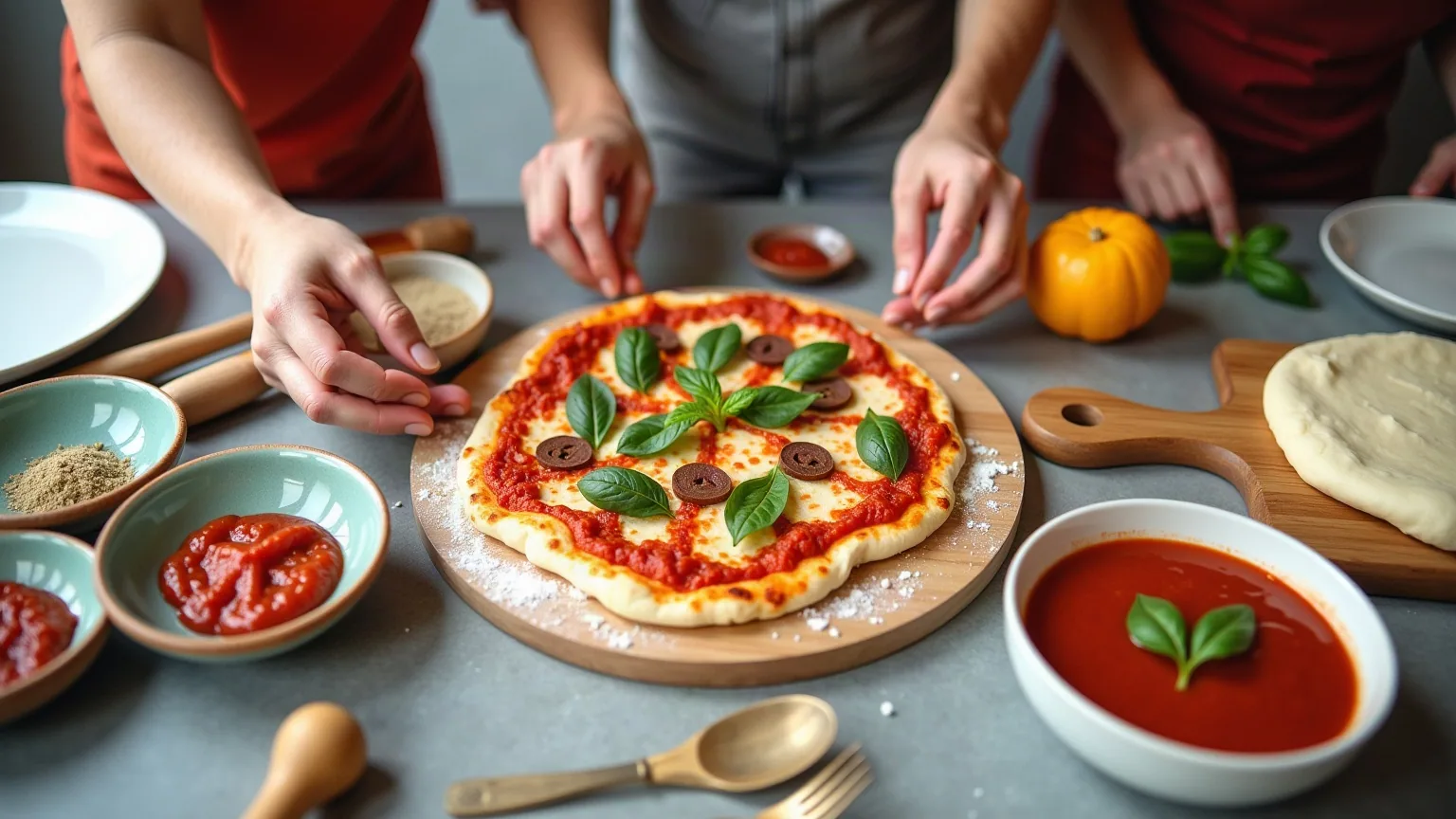
This is a party hosting guide: it shows where guests stand, who handles the food, how to stagger the cooking, and how to stop the first guests finishing before the last pizza is ready. If you only need to calculate how many pizzas to order, use the separate how-many-pizzas guide (draft link, confirm at publication).
Pick one of three pizza party formats
| Format | Recommended example group | Oven pressure | Best feature | Watch out for |
|---|---|---|---|---|
| Delivery-and-games | 12–24 | None at home | Simple, good for birthdays | Delivery timing and dietary orders |
| Make-your-own mini pizzas | 6–10 | High | Interactive activity and food together | Cooking queues, raw toppings, allergy contact |
| Slice-and-salad open house | 12–20 | Moderate if reheating, low if delivered | Guests eat when ready | Cold/over-held food, uneven slices |
These are sensible planning ranges rather than rigid limits. A household with two ovens and a couple of helpers can manage far more hands-on pizzas than someone working with a single small oven. Trying to let twenty guests make individual pizzas in a standard domestic oven usually means spending most of the evening waiting for food.
Plan 1: Delivery pizza plus a ready-made party programme
Scenario: sixteen guests, including ten teenagers and six adults, for a two-and-a-half-hour indoor birthday party. Food arrives thirty-five minutes after the gathering begins.
First, work out the pizza order using slices, not boxes. Here is an example calculation, based on an eight-slice large pizza and the following appetites:
- Ten teenagers × 3 slices = 30 slices.
- Six adults × 2 slices = 12 slices.
- Total expected demand = 42 slices.
- Order 6 eight-slice pizzas = 48 slices; six remain as a small buffer.
This assumes substantial sides, does not account for exceptionally hungry guests, and is not nutritional advice. Adjust the figures for younger children, bigger appetites, or if the pizza is replacing a full dinner. Check your supplier's actual slice count and pizza diameter—'large' varies considerably between pizzerias. Keep dietary-specific pizzas clearly labelled, and never assume a vegetarian option is safe for someone with a severe food allergy.
Two-and-a-half-hour schedule
| Elapsed time | Activity | Host responsibility |
|---|---|---|
| 0:00–0:20 | Guests arrive, simple table game | Show drinks, check arrivals |
| 0:20–0:35 | Two short party games or conversation | Clear space for pizza boxes |
| 0:35–1:00 | Pizza arrives and is served | Check order and allergens immediately |
| 1:00–1:35 | Group game, quiz or photo challenge | Keep water topped up |
| 1:35–1:55 | Cake or dessert | Collect used plates first |
| 1:55–2:20 | Relaxed activity and packing up | Check collection arrangements |
| 2:20–2:30 | Departures | Return belongings, tidy food safely |
Delivery contingency: set an arrival-time window when ordering and keep the supplier's phone number handy. If the food is delayed, bring the 1:00 game forward rather than serving a handful of guests while everyone else waits. Avoid promising food at an exact minute; traffic and kitchen delays happen.
How to avoid fighting over topping choices
Send a quick message three days beforehand: “Any dietary requirements or toppings you can't eat? Please reply by Thursday.” Then split the order across crowd-pleasing classics rather than juggling a dozen bespoke combinations. For sixteen guests, a sensible starting point is two cheese, two pepperoni (or equivalent favourites), one vegetable, and one dedicated dietary option only after confirming what that guest can safely eat. This is purely illustrative—let your actual replies decide.
Put out two large salads or bowls of vegetables, alongside a water dispenser or jugs. It gives guests an alternative to piling on extra slices without creating another complicated dish to cook.
Plan 2: Make-your-own mini pizzas for eight children
This format doubles as food and entertainment: children assemble a small pizza, an adult bakes it, and the kids play a quick game while it cooks. Where it falls down is when it turns into an unruly free-for-all, with children scrambling across one another's dough, utensils, and raw ingredients.
Ingredients and shopping list for eight
Plan for one personal pizza per child using bases roughly 15–18 cm across, plus one or two spares for dropped dough or bigger appetites. These are practical kitchen estimates, not tested product yields; adjust them according to your dough recipe and the children's ages.
| Ingredient | Working quantity | Why |
|---|---|---|
| Small pizza bases | 9 | Eight guests plus one spare |
| Tomato pizza sauce | 350 g | Roughly 35–40 g per base |
| Grated mozzarella or suitable alternative | 450 g | Roughly 50 g per base |
| Chopped sweet pepper | 2 medium | Colour and crunch |
| Sweetcorn | 1 small can, drained | Popular simple topping |
| Sliced mushrooms | 150 g | Optional vegetable bowl |
| Pre-cooked chicken or suitable substitute | 200 g | Only if guests want it; handle chilled |
| Pitted olives | 1 small jar | Optional, cut appropriately for age |
| Baking paper | Enough for oven trays | Keeps portions identifiable |
| Name labels and markers | 9 | Stops mix-ups |
If you are using raw meat or fish, do not let children handle it at a ready-to-eat topping station. Stick to cooked, chilled, properly stored toppings, with any raw items kept in an adult-only prep area. Follow the Food Standards Agency's cooking advice and packaging instructions to make sure everything is thoroughly cooked through. Check allergies and read labels carefully before shopping. If a child has a severe allergy, speak with their parents directly rather than assuming a shared topping bar can be made safe.
The kitchen bottleneck calculation
Suppose your oven comfortably fits three mini pizzas per batch and each batch takes twelve minutes plus three minutes loading and unloading.
- Eight pizzas ÷ three per batch = three batches (rounded up).
- Three × fifteen minutes = approximately 45 minutes of oven time.
- Add possible preheating and topping delays.
Those times are only examples: actual temperature, cook time and throughput depend on equipment, dough and manufacturer instructions. Do a rehearsal with one pizza in advance. If your oven holds only two at once, the same calculation becomes four batches, around 60 minutes. That is a party activity, not a ten-minute cooking step.
Ninety-minute activity block
- First 10 minutes: wash hands, put on aprons, show the named boards and explain “one spoon per topping.”
- Next 15 minutes: children spread sauce and choose toppings while an adult supervises. Keep toppings in small refillable bowls and chilled backup portions in the refrigerator.
- Next 45 minutes: bake in batches. Run a nearby colouring challenge or pizza-box art activity for children whose pizzas are not in the oven. Adults manage all hot trays and oven access.
- Last 20 minutes: serve pizzas in a planned order, eat and clear the station. If necessary, serve in two waves and explain this beforehand rather than letting children wait hungrily without knowing when theirs comes.
For children who cannot wait that long or whose allergies require separate preparation, arrange a ready-to-serve alternative with their parents in advance. The goal is easy, inclusive fun, not forcing every child through an identical assembly line.
Plan 3: An adult pizza-and-salad open house
When guests are dropping in across a three-hour window, an assemble-your-own setup usually falls flat. Instead, plan for two planned food waves so later arrivals still get fresh pizza and early guests don't eat through the entire spread at once.
Example: twenty adults, six to nine pm.
- 6:00 pm: welcome drinks, antipasti or crisp vegetable platter. Put a clear “food at 6:45” note on the invitation.
- 6:45 pm: first pizza wave, roughly half the order, plus a substantial mixed salad.
- 7:45 pm: second pizza wave; refresh clean plates and drinks.
- 8:30 pm: dessert, tea or coffee.
- 9:00 pm: finish; refrigerate suitable leftovers promptly.
Staggering a delivery requires agreeing times with the takeaway or placing two separate orders. You can also bake in batches at home, provided your oven can keep up. Gauge how hungry people actually are after the first round; ordering another ten pizzas is pointless if most guests are already satisfied. When in doubt, scale back the second order and pad it out with sides.
For vegan guests or anyone avoiding specific ingredients, provide a proper, clearly marked main option rather than leaving them with a side salad. Check dietary needs early and label toppings clearly; remember that cross-contamination in the kitchen, takeaway, or on the pizza board can be as critical as the ingredients themselves. The government's allergen checklist offers helpful principles here, even though it is aimed at catering businesses.
How much pizza should you order?
Use this formula:
Pizzas = round up [(guests × expected slices per guest) ÷ slices per pizza].
A more reliable approach is to split your guest list into groups:
Total slices = (children × child allowance) + (teens × teen allowance) + (adults × adult allowance).
Then add a buffer if appetites are unpredictable, the pizzas are thin or small, or sides are minimal. Here is a worked illustration rather than a rigid rule:
| Guests | Example slices each | Total | 8-slice pizzas |
|---|---|---|---|
| 10 younger children | 2 | 20 | 3 (24 slices) |
| 16 mixed teens/adults | Varies: worked above | 42 | 6 (48 slices) |
| 20 adults with salads | 2.5 average | 50 | 7 (56 slices) |
Be realistic about portion sizes: a slice from a thin-crust medium is very different from a thick deep-pan slice. Children generally eat less, hungry adults eat more, and an event replacing an evening meal demands far more food than an afternoon drop-in. Our full pizza quantity article breaks down the maths in more detail without repeating the hosting advice here (draft link; validate before publishing).
Organise the pizza serving table
Set up the food table with a clear one-way flow. Place plates first, then pizza, salads next, and napkins and cutlery at the far end, keeping the drinks on a completely separate table. That stops guests crossing paths and gridlocking the line. For a buffet, place a dedicated slice server in every box or tray, and keep allergy-safe options well away from shared utensils.
With eight children, serve pizzas directly to their seats rather than calling a stampede to a hot counter. For twenty adults, put out only what guests can eat while it is hot and fresh; restock with clean trays instead of dumping fresh slices on top of cold leftovers. The FDA's buffet advice advises keeping cold food properly chilled, hot food hot, and throwing away perishable food left out too long. In UK catering settings, government cooking and holding guidance specifies that hot food must be held at 63°C or above unless a specific time exemption applies.
Leftovers: box up and refrigerate leftover pizza promptly, rather than leaving cartons open on the table until the party wraps up. The UK Food Standards Agency advises cooling leftovers and getting them into the fridge within two hours, eating them within 48 hours (or freezing them), and reheating only once until steaming hot throughout. Follow local food safety advice if you live elsewhere.
Five worthwhile games that fit a pizza party
These are simple, low-effort games to have in your back pocket, not mandatory entertainment.
Pizza-name challenge (5 minutes)
Guests invent and describe a fictional pizza in a single sentence, and everyone votes on the funniest description (rather than their favourite person). It works well if the delivery is running late, though you can skip it entirely if conversation is flowing.
Topping prediction (10 minutes)
Have each table guess the group's three most requested toppings, then reveal the real answers from your RSVPs. Award a point for every correct guess. It works across all ages and doesn't push anyone to eat anything they'd rather avoid.
Blind menu designer (10–15 minutes)
Give each team paper, a pretend budget, and a list of ingredients, then challenge them to build a menu that caters for vegetarians, allergy-conscious diners, and adventurous eaters. Compare ideas and have a laugh with the choices rather than judging anyone's tastes.
Pizza-box art (15 minutes)
Hand out plain paper or clean, unused takeaway boxes and felt tips, then let teams design their own pizzeria logo, name, and special meal deal. It is an easy way to keep hands busy while trays are in the oven.
Mini pizza trivia (10 minutes)
Put together five quick questions about pizza trivia or your guests' quirky food habits. Keep it light-hearted and simple, with an optional tie-breaker for the best name for a loaded vegetarian pizza.
A practical budget for sixteen guests
The figures below are purely illustrative, not a guarantee of local takeaway prices. Check your local pizzeria's menu before setting your final budget.
| Item | Example budget |
|---|---|
| Six ordered pizzas | £72 |
| Two salads or vegetable sides | £14 |
| Drinks including water and alcohol-free options | £18 |
| Dessert or birthday cake | £18 |
| Napkins, plates and spare bags | £6 |
| Subtotal | £128 |
| Optional ten-percent contingency (rounded) | £13 |
| Planning budget | £141 |
Two straightforward ways to cut costs are collecting the order yourself or making simple salads at home instead of buying sides. However, neither saves much if collection means a frantic dash across town or the salads clutter up prep space when you're already busy.
Pizza party mistakes to avoid
Letting everyone assemble at once. The topping table quickly turns chaotic and chilled ingredients sit warming up. Call children up in small groups to wash their hands and build their pizzas.
Having no oven plan. Base your timings on actual tray capacity and realistic bake times. The kitchen maths matters far more than having enough novelty aprons.
Counting guests but not appetites. Sixteen five-year-olds need a completely different order from sixteen teenagers straight off a football pitch.
Serving all pizzas at the start of a long event. People arriving late get stale food. Use planned waves or keep the gathering shorter.
Assuming removing one topping makes pizza allergen-free. Cross-contact happens easily during prep, baking, and slicing. Clarify dietary needs, check the takeaway's hygiene practices, and arrange dedicated safe alternatives well ahead of time.
Pizza party FAQs
Is make-your-own pizza a good party activity?
Yes for a small group with enough counter space, supervision and oven capacity. It is awkward for twenty guests around one household oven. Trial the process first and provide a waiting activity.
How many toppings do I need?
Three to five well-chosen toppings alongside cheese and tomato sauce are usually plenty. Offering too many varieties drives up costs, creates waste, and increases the risk of cross-contamination. Let RSVP replies guide your selection, and keep dietary-safe ingredients entirely separate.
What if guests do not all eat cheese?
Offer a genuinely suitable pizza with a verified base, sauce, and toppings, using clean cutters and separate prep areas. Never assume dairy-free cheese automatically covers every vegan or allergy requirement—check the packaging carefully.
Can I make pizza dough the day before?
Often, yes—cold-proofing in the fridge can work brilliantly, but follow a tested recipe for timings and storage. If you are hosting for the first time, good quality ready-made bases remove a huge amount of stress.
What should I serve with pizza?
Water, vegetable sticks, and a fresh green salad are plenty for most casual get-togethers. You only need to add heavier sides if the pizza itself is serving as a light bite rather than a full meal.
Final host checklist
- [ ] Ask guests about allergies, preferences and ages before ordering.
- [ ] Choose delivery, mini-pizza cooking or two-wave serving.
- [ ] Check slices per pizza or actual dough yield.
- [ ] Test oven capacity and cooking time if making pizzas.
- [ ] Plan cold storage and safe food-handling arrangements.
- [ ] Put drinks away from the pizza serving queue.
- [ ] Have a fifteen-minute alternative activity for a delayed delivery or oven batch.
- [ ] Refrigerate safe leftovers promptly and record dietary mix-ups rather than serving uncertain food.
A pizza party should feel easy because you have planned the food flow before anyone arrives. Start with realistic portions and one serving method; the theme follows naturally.
Sources and further reading
- FDA: serving safe buffets
- UK government: cooking and hot holding food
- Food Standards Agency: leftovers and reheating
- Food Standards Agency: allergen checklist for businesses
- How many pizzas for a party? — proposed internal draft link, verify before publishing.