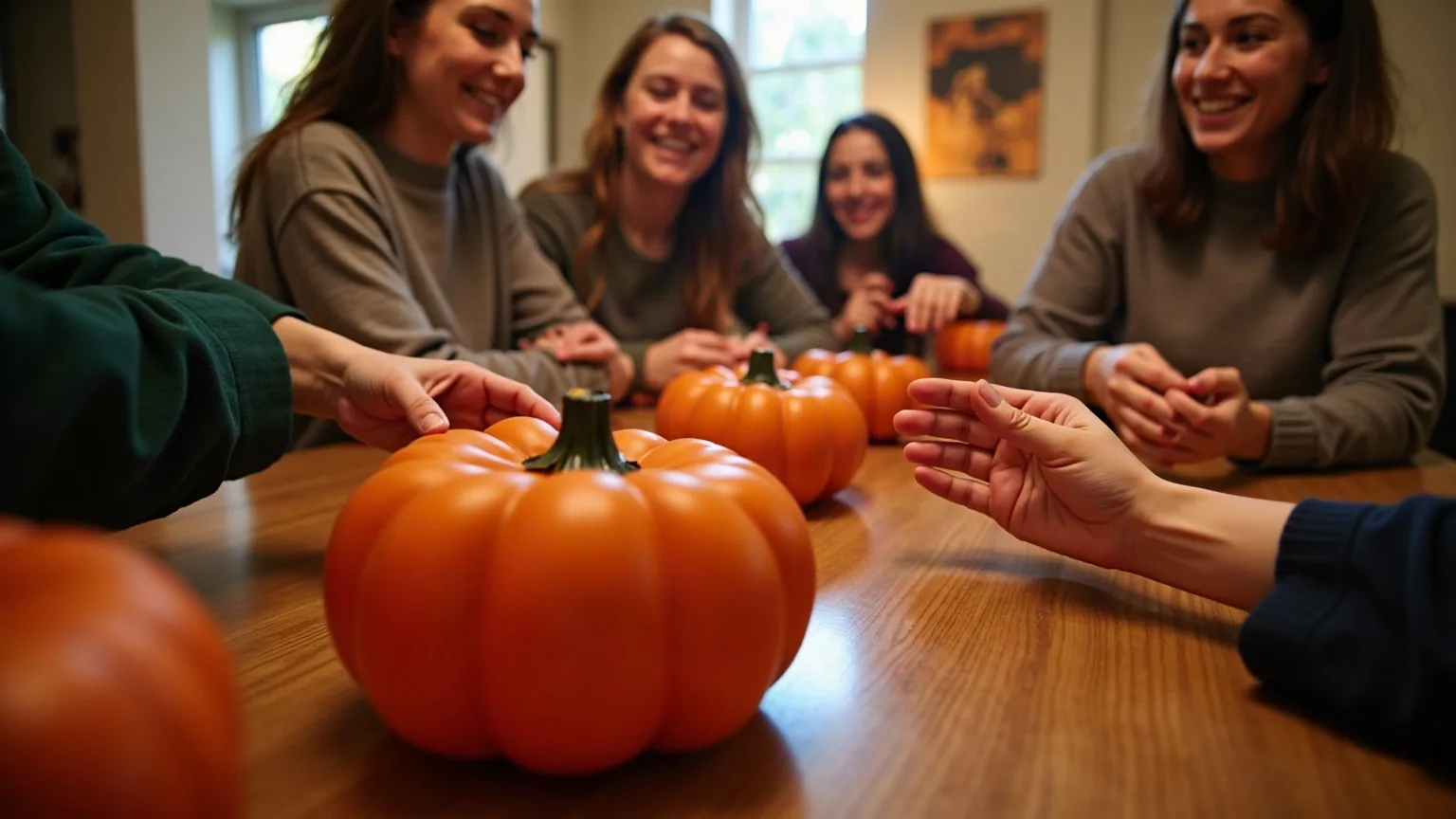
Here are ten games complete with supplies, player counts, estimated time, rules and a clear finish. Several include ready-made prompts and answers so you aren't stuck inventing puzzles on the spot. Nothing requires alcohol, pitch darkness, blindfolds, humiliation or unwanted contact.
For a complete party schedule, decorations, food, and safety tips, see Halloween party ideas at home. This guide focuses strictly on the entertainment.
Pick the game for the people in the room
| Game | Players | Allow | Supplies | Best for |
|---|---|---|---|---|
| Monster Freeze | 4–20 | 8 min | Music or clapping | Younger children |
| Moonlight Target Toss | 2–20 | 10 min | Paper balls, three containers | Children, mixed ages |
| Shadow-Card Recall | 3–16 | 10 min | Eight drawings, paper | Seated and mixed ages |
| Five-Clue Haunted Hunt | 3–12 | 15 min | Five clue cards | Families in one room |
| Ghost Charades | 4–24 | 15 min | Prompt slips and timer | Teens, adults, mixed teams |
| Sound Detective | 3–16 | 10 min | Six household sound-makers | Mixed ages, seated |
| Crypt Keeper's Code | 2–20 | 8 min | Cipher cards, pencils | Adults and older children |
| Spooky Sketch Relay | 4–20 | 12 min | Paper and pens | Teams, no running |
| Potion Pitch | 4–20 | 12 min | Word cards and score sheet | Adults and teens |
| Costume Detail Gallery | Any | 10 min | Optional paper slips | People who enjoy costumes |
All timings are host estimates, not promises. Add time if guests need movement or communication support. A spectator, scorekeeper, reader or team partner is a valid role.
1. Monster Freeze: a game where nobody gets eliminated
Prepare: line up a short playlist or have someone clap a steady beat. Clear a safe area well away from furniture and food tables.
Rules: players move around like silly monsters while the music plays. When it cuts out, everyone freezes. Rather than knocking out anyone who wobbles, the host simply calls out a new monster for the next round: sleepy zombie, tiny ghost, giant swamp creature, invisible cat, robot vampire. Run six to eight brisk rounds, each lasting about 30–40 seconds.
Winner: there isn't one. Set a collective challenge instead: can the whole room freeze instantly on the count of three? This spares younger children the sting of being knocked out after a single slip-up. Anyone who prefers not to dance can take charge of calling out the next monster.
2. Moonlight Target Toss: actual points, no heavy pumpkins
Kit: three empty containers marked 1, 2, and 3, plus six to nine crumpled paper balls or soft beanbags. Line the tubs up at increasing distances behind a marked throwing line.
Each player gets three throws. Any throw that lands and stays inside a tub scores the points marked on it; misses score zero. Tally up each total. Maximum score per person: 9 points if all three land in the top tub.
For team play, combine the scores of three nominated throwers from each side; maximum team score: 27. If team sizes vary, have each side field the same number of players, or simply calculate the average score per person. Let younger children throw from a closer marker, but either track their scores separately or agree on a clear handicap beforehand.
Avoid using actual pumpkins as bowling balls, and ensure everyone waits safely behind the line between turns. Screwed-up paper balls are far quieter and take seconds to gather up in a small room.
3. Shadow-Card Recall: a ten-minute table game
Draw or print these eight silhouettes onto separate cards: bat, cat, broom, moon, spider, pumpkin, witch's hat, owl. Lay them face up for 20 seconds, turn them face down, and challenge teams to write down every item they can recall.
Award one point for each of the eight correct items, accepting rough spelling. Maximum eight points. In the event of a tie, show a ninth silhouette (such as a key) for five seconds and have them sketch it from memory. For an accessible, non-visual alternative, read the eight items aloud twice and let players answer verbally.
For older players, add a quick twist: once they have written down the items, have them arrange the physical cards in the exact order they first appeared, scoring up to eight bonus points. Just be sure to mention this secondary challenge before revealing the cards.
4. Five-Clue Haunted Hunt: a complete clue trail
This works best as a small indoor search rather than a free-for-all scramble through cupboards and bedrooms. Stick to a single communal room and visible furniture. Check every spot beforehand, keeping clues well clear of food prep areas, breakables, and power points.
Write the text onto five separate cards. Hand card 1 directly to the players, then hide card 2 by the clock, card 3 near the mirror, card 4 on a bookshelf, and card 5 by the shoe rack, leaving a final congratulations note at the coat stand. If your room lacks any of these features, swap in safe alternatives and adjust the clue wording first.
- "I tell you the time but never speak." → Clock.
- "I show your face but never take a picture." → Mirror.
- "I hold many stories, all sitting on shelves." → Bookshelf.
- "When the walk is done, your footwear waits near me." → Shoe rack.
- "I keep jackets hanging but never get cold." → Coat stand.
Have the players find each card in turn and bring it back to the host. It works best at an unhurried pace, wrapping up once they reach the final note. If splitting into teams, set up two colour-coded trails of equal length so players aren't squabbling over the same clue. Always place cards at reachable eye level—never inside fridges, behind heavy furniture, or anywhere that requires climbing.
5. Ghost Charades: 12 prompts you can use immediately
Split the room into two teams and write the twelve prompts below onto individual slips of paper. Each turn lasts 45 seconds. A volunteer mimes without speaking while their teammates guess. Naming the action correctly before the timer rings scores one point; an incorrect guess or timeout scores zero. Alternate between teams across twelve rounds, making six points per team.
Prompts: ghost trying to use a phone; witch riding a bicycle; vampire brushing teeth; pumpkin rolling downhill; mummy unwrapping a parcel; skeleton putting on socks; bat stuck in an umbrella; zombie baking a cake; spider learning to dance; haunted doorbell; frightened scarecrow; monster trying to be quiet.
A reader can whisper the card to anyone with visual impairment, and players can easily mime from a chair if preferred. If the room gets too loud for spoken guesses, switch to mini whiteboards or scrap paper. No one should feel pressured into performing solo—timid players can always team up with a partner.
6. Sound Detective: six everyday noises
Seat players facing away from a small table so they can hear clearly without peeking. The host produces six distinct sounds, one at a time, behind a screen or inside an open box, without placing dangerous objects where guests can reach them.
Try these: keys gently shaken, paper torn once, a zipper opened, rice shaken in a sealed container, coins dropped onto a tray, a wooden spoon tapped against a mug. Pause for roughly ten seconds between each noise to let teams write down their guesses, then have them swap papers to mark.
Score one point for each correctly identified action or object, up to a maximum of six. Be generous with wording—treat "jingling keys" and "keys shaking" as identical. Reveal the items afterwards. For guests with hearing difficulties, swap in short muted video clips or an alternative visual-memory round, ensuring no one is penalised for accessibility adjustments.
7. Crypt Keeper's Code: two puzzles with correct answers
Hand each team the number key A=1, B=2, ... Z=26. Numbers separated by hyphens represent letters, while gaps between clusters indicate spaces between words. Here are two ready-to-use messages:
- Puzzle A:
6-9-14-4 / 20-8-5 / 11-5-25 - Puzzle B:
13-5-5-20 / 1-20 / 20-1-2-12-5
Answer key for the host: A = FIND THE KEY; B = MEET AT TABLE. Remind players these are simply themed phrases to crack on paper, not literal instructions to search the house. Allow two minutes per puzzle. Score two points for an independent solve, one point if they needed a clue, and zero if time runs out. That gives a possible four points per team.
If groups get stuck, offer a small nudge by revealing that 1=A, 5=E and 20=T. Always give hints to the whole room at the same time to keep things fair. It's a straightforward, pen-and-paper cipher that doesn't need apps, padlocks, or complicated setup.
8. Spooky Sketch Relay: drawing rather than racing
In teams of two to five, players take turns sketching a prompt on paper. Each round lasts one minute. A team scores one point if they correctly guess the drawing before the buzzer sounds, then hands the pen to the next artist.
Work through these prompts in sequence: a pumpkin with spectacles, a ghost holding an umbrella, a crooked haunted house, a skeleton playing football, a black cat in a cardboard box, a witch making toast. With six prompts, that offers a maximum six points. If running two competing teams simultaneously, give each side an identical list so the difficulty stays level.
The "relay" refers to passing the marker around the table, not running across the room. A teammate can happily sketch on behalf of anyone who finds holding a pen uncomfortable.
9. Potion Pitch: an original word game, not actual chemistry
Deal each team three imaginary ingredient cards drawn from this list: moon dust, dragon pepper, thunder mist, batty bubbles, silver snow, purple fog, giant's sneeze, sleepy stars, swamp sparkle. Give them two minutes to come up with a catchy potion name, its harmless imaginary effect, and a snappy 30-second sales pitch.
Scoring: award one point for naming all three ingredients, one for giving the potion a distinct title, one for detailing an imaginary effect, and one for keeping the pitch under 30 seconds. Maximum four points per team. Keep criteria objective: check off the four requirements rather than trying to judge comedy or acting ability.
Do not mix household cleaners, medicines, or unidentified liquids as a party stunt. Keeping the brewing entirely imaginary removes any need for mess, chemical handling, or questionable taste tests.
10. Costume Detail Gallery: a no-pressure finale
Instead of running a high-stakes "best costume" contest, invite volunteers only to highlight one single detail they made or picked out—such as a handmade badge, a prop crafted from cardboard, a quirky hat, or an unusual colour scheme. Each participant can speak for 20 seconds, or have the host read a quick note on their behalf.
Rather than ranking guests from first to last, hand out positive recognitions such as most creative use of paper, cleverest reused object, unexpected colour combination, best handmade detail. Give a small certificate or card to everyone who takes part. Guests should always feel welcome without dressing up, posing for photos, or being scrutinised, and children shouldn't feel that expensive outfits hold an unfair advantage.
Three ready-made game programmes
Younger children: 45 minutes of activities within a 90-minute party
| Place in event | Activity | Allow |
|---|---|---|
| After arrivals | Monster Freeze | 8 min |
| Next | Moonlight Target Toss | 10 min |
| Quiet break | Water, seating and transition | 7 min |
| Middle | Five-Clue Haunted Hunt | 15 min |
| Finale | Costume Detail Gallery, optional | 5 min |
| Total | 45 min |
Food, arrivals and collection fit into the remaining 45 minutes of the event. See the whole plan in Halloween party ideas.
Mixed ages: three activities across two hours
Set out Shadow-Card Recall as an informal icebreaker during the first 20 minutes. Gather everyone for 15 minutes of Ghost Charades once the room has filled up, and finish with ten minutes of Sound Detective—or keep it at a side table for casual play. There is no need to interrupt natural conversation by forcing everyone to join in every round.
Adults: one focused round, not a forced evening
Once guests have eaten, introduce Crypt Keeper's Code for about 8 minutes, followed by Potion Pitch for around 12 minutes with willing volunteers. Keep a drawing round in reserve only if people ask for more. The rest of the evening can stay relaxed and social rather than turning into an exhausting games tournament.
Supplies checklist for a low-cost games night
You can run almost every activity on this list using just paper, pencils, a marker, adhesive putty, a timer, three empty tubs and soft paper balls. If you are splitting larger groups into parallel teams, print duplicate sets of clues and keep master answers tucked in a separate envelope. Take five minutes to walk through hiding spots, scoring sheets, and timings before guests arrive.
For a wider selection of non-seasonal activities, our guides to adult party games and party games for five-year-olds cover different occasions. Feel free to adapt suitable formats, but avoid duplicating identical rule sets under the guise of fresh Halloween content.
Three mistakes that spoil a Halloween game
- Rules requiring physical contact without agreement. Wrap-a-person races, blindfold hunts and dark-room pursuits can be awkward or unsafe. Choose a tabletop alternative that guests can opt into.
- Scoring that changes halfway through. Write the points and tie-breaker on the host sheet first. Let every team have equal numbers of turns.
- A game that lasts longer than the group's patience. Announce a clear endpoint. Stop after a good round rather than making participants repeat the same activity until someone gets bored.
Frequently asked questions
What are good Halloween party games for adults?
Ghost Charades, Crypt Keeper's Code, Potion Pitch, and a quick sketch contest all work smoothly because the rules take less than a minute to explain. Team formats ensure nobody feels put on the spot, and a light-hearted puzzle trail builds an eerie atmosphere without resorting to drinking challenges or jump scares.
Can I run Halloween games in a small living room?
Yes. Shadow-Card Recall, Sound Detective, Crypt Keeper's Code, Spooky Sketch Relay, and Potion Pitch can all be played comfortably around a dining table. Save throwing and active movement games for rooms with plenty of clear floor space, and skip them altogether if space is tight.
How many games fit a 90-minute children's Halloween party?
Two or three short games separated by a snack and drink break are far easier to manage than a non-stop programme. The sample schedule above sets aside 45 minutes for structured play, leaving plenty of breathing room for arrivals, eating, and home time.
What if guests don't want to play?
Let them spectate, read out clues, track points, or simply chat in another corner of the room. An optional game enjoyed by five willing players is always better than a mandatory activity that makes fifteen people feel awkward.
The practical rule: pick your games in advance, print the clue cards, check the answers, and decide on a clear finishing time. Everything beyond that is purely optional.
Safety reference: fire services recommend keeping exit routes unobstructed, swapping naked flames for battery-powered LEDs, and ensuring costumes and decorations don't restrict vision; see guidance from Buckinghamshire Fire & Rescue Service. For general advice on catering and venue safety, consult our companion Halloween party guide.