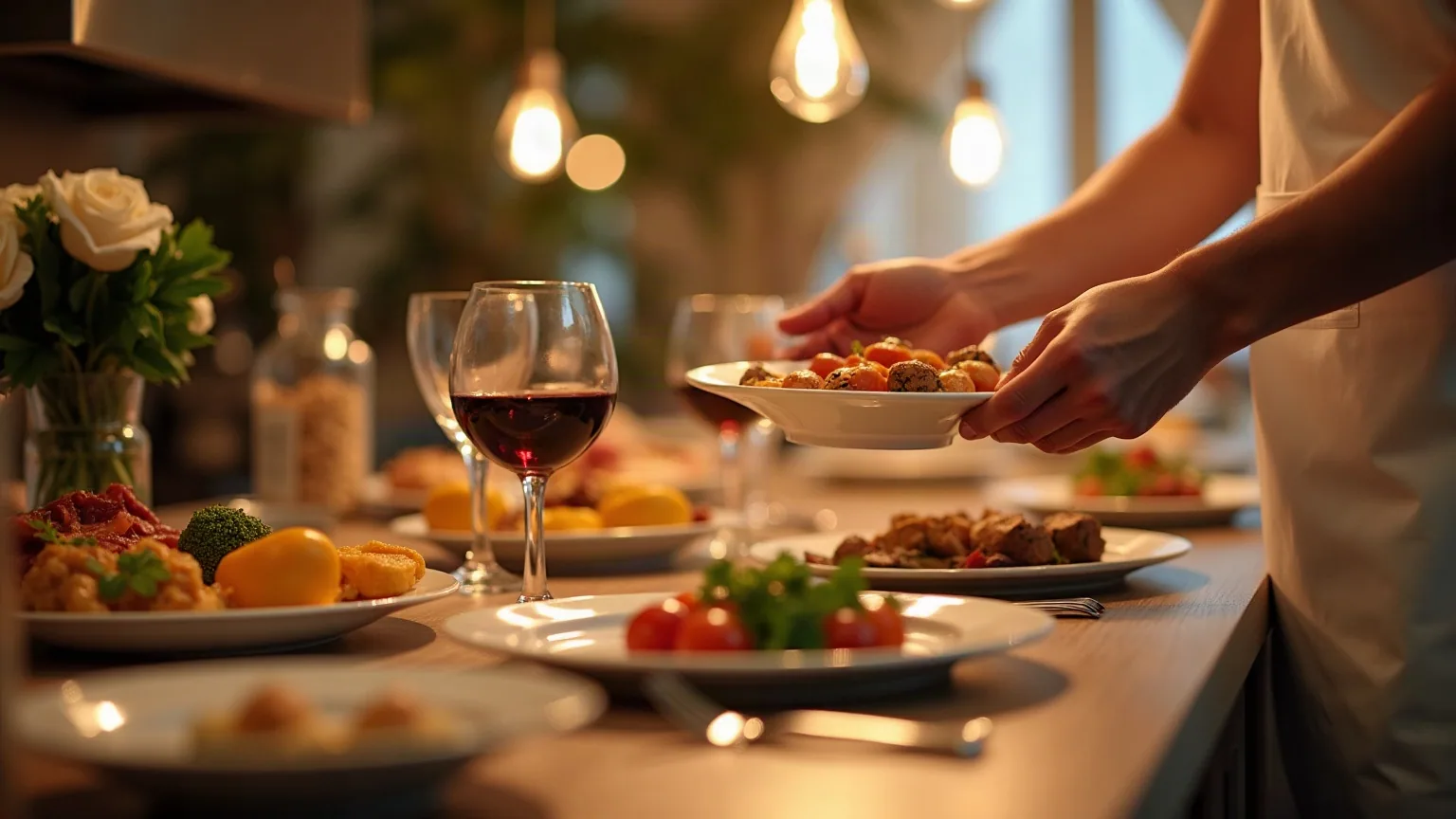
This is a practical working checklist for a sit-down dinner for six, eight or twelve. It covers menu planning, portion estimates, and a step-by-step countdown from the week before through to the final plate. For overall guest lists and party setup, see our general party planning checklist; this guide focuses strictly on making a seated meal run smoothly.
Start with the menu's bottleneck
Pick the main course first, then ask four questions:
- What occupies the oven, and when? A roast that needs the oven until the moment you serve cannot share that same oven with three sides needing different temperatures.
- What must be cooked to order? Pan-frying six steaks might be manageable; twelve steaks with different preferences can turn dinner into restaurant service.
- What can wait? A braise often holds and reheats better than delicate fish. A chilled starter gives the cook time to concentrate on the main course.
- Who is clearing and serving? If you are hosting alone, choose fewer final-minute jobs.
A sensible three-course structure is cold or make-ahead starter + one main with two sides + pre-prepared dessert. Keep in mind that three courses are optional. A standout main and dessert will always beat a rushed starter.
Three workable dinner-party formats
| Guest count | Practical format | What needs doing at serving time |
|---|---|---|
| 6 | Individual starters, a roast or traybake main, one shared dessert | Plate starters, finish vegetables, carve or portion main |
| 8 | Shared platter starter, make-ahead stew or vegetable bake, simple dessert | Reheat main safely, prepare one fresh side, serve family-style |
| 12 | Cold starter board, two large pre-planned main options, tray or bowl dessert | Put labelled dishes on table, replenish safely, clear in stages |
For twelve guests, plan how food and plates will actually move from the kitchen to the table. If two people have dietary requirements, prepare one genuinely complete alternative rather than leaving them to cobble together a meal from side dishes. Clearly label allergens and avoid cross-contact by checking labels and assigning separate serving utensils rather than guessing.
Example: a dinner for eight with quantities
Here is a planning example, not a guarantee that every guest eats identical amounts. Adjust portions to suit your recipes, your guests' appetites, and whether you are serving a substantial starter.
Menu: tomato-and-bean crostini, slow-cooked vegetable and chickpea casserole with rice and salad, and eight individual lemon desserts.
| Component | Planning amount for 8 | Notes |
|---|---|---|
| Crostini | 16 small pieces | Two pieces each; a light starter |
| Casserole | 8 generous recipe-defined portions | Prepare in an ovenproof pot or two dishes |
| Dry rice | About 560 g | 70 g per person; recipe and side dishes may change this |
| Mixed salad | 1 large bowl, roughly 8 side portions | Dress immediately before serving |
| Dessert | 8 portions, plus a spare if convenient | Portion ahead so you are not cutting cake at the table |
| Water | Pitchers or jugs, refilled as needed | Put water out before anyone sits |
These are serving estimates, not dietary rules. If several guests do not eat rice, do not cook 560 g on autopilot. If you are serving meat, follow the recipe's recommended internal temperature and verify it with a digital probe thermometer rather than relying on colour alone. Always stick to tested instructions for specific dishes.
Seven days before: decisions that cannot wait
- Confirm the date, start time, food service time, guest count and each attendee's dietary requirements. Ask whether there are serious allergies and what precautions are needed.
- Agree the format: plated or dishes shared at the table. A tiny dining table with twelve place settings is a practical problem, not a decoration problem.
- Test the table layout using actual chairs and plates. Check that guests can get to the toilet without moving other seated guests.
- Choose recipes you have cooked before, or test unfamiliar ones on a smaller scale; don't use guests as a first trial of a complicated method.
- Write one shopping list organised by produce, chilled items, pantry goods and equipment. Add serving spoons, oven trays, trivets, containers and a working food thermometer.
Use the guest-list planner to confirm final numbers. Send a clear invitation stating both the arrival time and when you plan to sit down to eat; see the dinner invitation template if you need sample wording.
Two days before: the kitchen capacity check
Before shopping for perishables, clear enough space in the fridge and freezer. You need room to cool cooked dishes quickly and store raw ingredients safely apart. Only prep desserts or sauces in advance if the recipe and food safety guidelines specifically permit it.
Set out your serving dishes and pans on the worktop beforehand. Check your hob rings, oven shelf space, and serving bowls. For twelve people, borrow a couple of platters in advance rather than realising at 7 p.m. that there is nowhere to put the hot main.
If the fridge is full, revise the menu. Stashing cold food in a chilly hallway or garage is not a safe workaround. The FDA's buffet guidance recommends serving smaller portions, refrigerating leftovers promptly, and holding hot and cold foods at the correct temperatures. Follow the food safety guidance for your region.
One day before: make a cook's running order
Draft one timeline for the kitchen, not just a loose to-do list. Here is an example for a 7:30 p.m. dinner:
| Time | Job | Who does it |
|---|---|---|
| Morning or afternoon | Prepare approved make-ahead dessert and chill | Host |
| 5:45 p.m. | Clear counter; prepare vegetables and starter components | Host |
| 6:00 p.m. | Begin casserole reheating/cooking according to tested recipe | Host |
| 6:30 p.m. | Set table; water, glasses and napkins ready | Helper |
| 7:00 p.m. | Guests arrive; serve drinks and light nibbles | Helper |
| 7:15 p.m. | Assemble cold starter; finish rice and hot food | Host |
| 7:30 p.m. | Serve starter | Host/helper |
| 7:50 p.m. | Serve main when foods are safely ready | Host/helper |
| 8:35 p.m. | Bring out pre-portioned dessert | Host/helper |
Those clock times are illustrative. Actual cooking durations should always come from your specific recipe. If a main takes an hour at a set oven temperature, schedule it accordingly. Always factor in a ten- to twenty-minute cushion before serving, particularly when multiple dishes compete for oven space.
For a more comprehensive advance-prep plan, consult our 48-hour party food preparation guide; this page focuses strictly on a seated meal.
On the day: four jobs in the right order
1. Set the table before cooking gets busy. Lay out plates, cutlery, water glasses, and trivets. Allocate dedicated serving utensils for every platter, particularly for allergen-free dishes.
2. Chill and heat food correctly. Keep food properly chilled or hot. Avoid leaving meat, dairy, cooked rice, or seafood sitting on the worktop for an hour just to look decorative. The FDA buffet advice gives US holding benchmarks of 40°F/4°C or colder for cold foods and 140°F/60°C or hotter for hot foods. Follow local public health rules and the food's specific storage instructions.
3. Give guests something to do while you plate. A drinks jug, a simple cold starter, and a friend or partner who can pour wine and clear plates will do far more for the evening than elaborate decorations.
4. Serve according to readiness, not the clock alone. Let guests know if the main needs another few minutes. Never cut cooking times short or skip temperature checks simply to keep to an arbitrary schedule.
Common failures—and the adjustment that fixes each
| Problem | Better plan |
|---|---|
| All side dishes need the oven together | Choose one cold/room-temperature side or one hob dish |
| Twelve separate portions need last-second plating | Serve in two shared dishes and let guests pass food |
| Starter fills guests before the main | Cut the starter to two small bites or omit it |
| One guest has an allergy | Confirm details in advance; use verified suitable ingredients and protected utensils |
| You have only six chairs for eight guests | Change the format, borrow seats or reduce guest count; don't create a blocked route |
| Dessert needs thirty minutes of active work | Make it ahead and chill or serve fruit and a prepared sweet |
The final ten-minute dinner checklist
- [ ] Hot and cold foods are at appropriate serving temperatures.
- [ ] Water, glasses and every guest's place setting are ready.
- [ ] Allergen-sensitive meals have been handled separately and checked.
- [ ] One serving utensil is assigned to each dish.
- [ ] A suitable place is clear for hot cookware.
- [ ] Guests can pass through doorways and reach exits without obstacles.
- [ ] Food for anyone arriving late can be kept safely, not left on the table.
The result to aim for: you actually sit down and enjoy the meal alongside your guests. If your plan leaves you standing at the cooker all evening, rethink the menu, not the guest list.