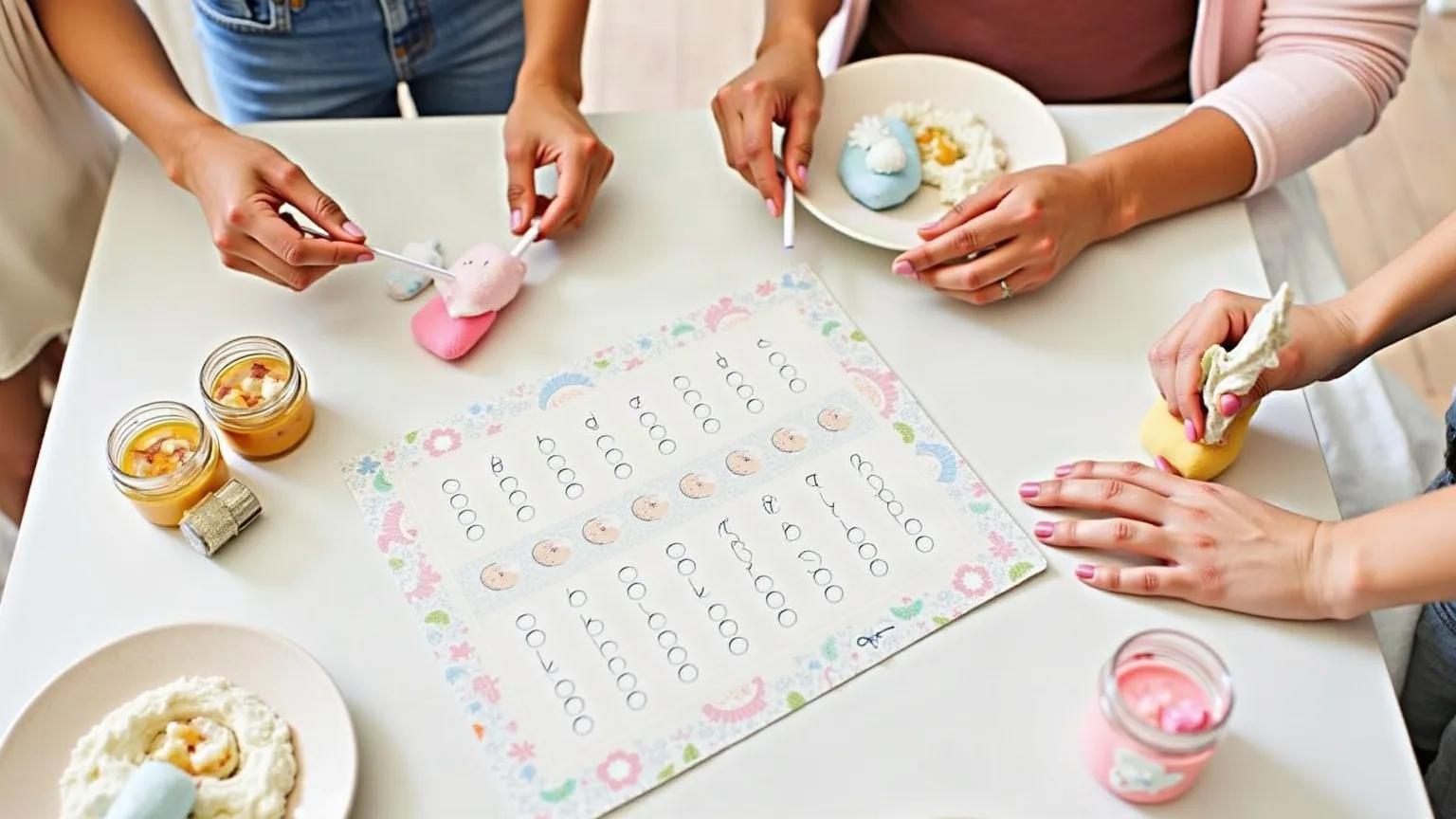
Below are nine games complete with materials, set-up, rules, duration and an alternative for shy or mixed-age groups. None requires guessing the pregnant person's measurements, sharing intimate details or forcing guests to perform. Always check with the guest of honour beforehand whether games are welcome at all.
Choose games by group, not by what's trending
| Group | Best combination | Approximate active time |
|---|---|---|
| 6–10 friends who know one another | Baby Item Memory, Who's Most Likely?, Welcome Notes | 25 minutes |
| 12–20 mixed friends and relatives | Connection Bingo, The Great Bag Pack, Baby Item Memory | 30 minutes |
| Guests who dislike competitive games | Welcome Notes, Story Starters, Make a Family Playlist | Flexible drop-in |
| Short 90-minute shower | One five-minute icebreaker and one ten-minute game | 15 minutes |
These are suggested timings, not rigid rules. If conversation is flowing naturally, you can easily skip any remaining games.
1. Baby Item Memory Tray
Best for: 6–25 seated guests. Duration: 8 minutes. Materials: a tray or large cloth, 12 common baby items, paper and pens, a timer.
Set-up: arrange items such as a soft bib, sock, washcloth, muslin/burp cloth, baby spoon, soft brush, mitt, small book, bottle, nappy/diaper, pacifier/dummy and a toy. Use safe demonstration items, keeping loose small parts out of reach of young children. Cover the tray before guests arrive.
Rules:
- Reveal the tray for 45 seconds. Guests look but do not take photos.
- Cover it again and give everyone two minutes to write down what they remember.
- Award one point for each correct item; if you want a tie-breaker, ask the colour of the bib or the picture on the book.
- Let people compare answers without reading every sheet aloud.
Make it easier: reveal ten items rather than twelve, or let guests work in pairs. This suits quieter groups well, as nobody has to stand up or speak across the room.
2. Connection Bingo (not baby trivia)
Best for: guests who do not all know each other. Duration: 8–10 minutes. Materials: a 3×3 bingo card and pens.
Create nine squares with ordinary prompts such as has a dog, enjoys gardening, has travelled by train this month, likes spicy food, can bake bread, has a sibling, speaks another language, has lived in another town, prefers tea to coffee.
Rules: guests mingle and write a person's name in a square when it matches. Each person can only appear once per card. The first guest to complete a line can call 'bingo', but avoid cutting the room off immediately—give people time to finish their conversations.
Important: avoid prompts that touch on fertility history, relationship status, pregnancy experiences or private health matters. For a seated group or anyone with limited mobility, let guests call out answers together or have the host introduce people.
3. Who's Most Likely? — Parents' Edition
Best for: groups that know the parents well. Duration: 5–8 minutes. Materials: eight prepared questions, two name cards per guest.
Set-up: ask both parents-to-be (where applicable) if they are comfortable with a lighthearted quiz. Use questions they have vetted beforehand, such as: 'Who is more likely to pack extra snacks?', 'Who would build a flat-pack cot first?', 'Who would remember the camera?', or 'Who would invent a bedtime story?'
Rules: read out a question and ask guests to hold up their chosen name card. The parents then reveal their own playful answer. Keeping score is optional; the fun is in the discussion, not a formal test of parenting ability.
Alternative: for a solo parent-to-be, switch to 'Which would they choose?' with two options, such as a beach trip versus a mountain walk. Never force a two-parent format where it does not fit.
4. The Great Baby Bag Pack
Best for: 8–20 guests working in small teams. Duration: 10 minutes. Materials: a tote bag, a selection of clean baby-care props or picture cards, and paper.
Set-up: prepare more items than the bag actually needs: nappy/diaper, wipes, change of clothes, muslin cloth, spare bag, sunscreen, soft toy, oversized toy, adult magazine, spare hair tie, water bottle and so on. The game is about practical thinking, not teaching medical advice.
Rules: each team chooses six essentials for a short outing with a baby and has two minutes to explain its choices. There is no single 'perfect' list; instead, award a point for sensible reasoning, such as a change of clothes after a spill, and a bonus for remembering a bag for soiled items. Afterwards, ask the parent-to-be which item surprised them.
No equipment version: write a list of 15 items and let groups circle their six choices. A team can pass rather than presenting to the whole room.
5. Guess the Baby Item from Three Clues
Best for: mixed generations and seated groups. Duration: 6–8 minutes. Materials: host clue cards and paper answer sheets.
Rules: read the three clues one at a time. Guests get three points for guessing after the first clue, two after the second, and one after the third. Cap it at five items so the game stays brisk.
Use these five ready-to-read sets:
| Answer | Clue 1 | Clue 2 | Clue 3 |
|---|---|---|---|
| Bib | Often made of fabric or silicone | Helps during a messy routine | Worn around the neck during meals |
| Muslin cloth / burp cloth | Usually lightweight | Often kept within arm's reach | Useful for wiping up little spills |
| Baby monitor | Helps from a different room | May transmit sound or video | Lets you hear when a baby wakes |
| Changing mat | Can be portable | Often wipes clean | Used during nappy changes |
| Storybook | Has pages | Grown-ups can use it every day | Read aloud at bedtime |
Accept regional alternatives such as nappy/diaper, dummy/pacifier and muslin/burp cloth. The clues given here are original examples for this guide rather than a rigid template.
6. Baby Name Initials Challenge
Best for: lively groups, without putting pressure on the parents to reveal the baby's real name. Duration: 5 minutes. Materials: a sheet listing five letters, plus pens.
Write five common initials on the page—for example, A, M, S, J, L. Give everyone one minute to invent one fictional baby name for each letter. The host reads out a selection, and guests vote for the most imaginative made-up option.
Ground rules: nobody should feel pushed to disclose the actual baby's name, preferred gender, family naming choices or private background. If the family does not want a naming game, choose another activity.
7. Welcome Notes for the New Family
Best for: groups of any size; no competition required. Duration: drop-in over 15–30 minutes. Materials: postcards or folded paper, pens and a collection box.
Leave three prompts on the table:
- 'One practical thing I can help with after the baby arrives is…'
- 'My hope for your family this year is…'
- 'A moment I hope you remember is…'
Guests choose one and leave a note. Do not require people to give parenting advice or share personal family history. If the parents want privacy, put the finished cards in a sealed envelope instead of reading them aloud to the room.
This activity works especially well for gatherings where grandparents, colleagues and friends might not otherwise share much common ground.
8. Make a Family Playlist
Best for: a relaxed baby shower where guests enjoy music. Duration: 5 minutes plus optional playlist creation later. Materials: paper slips or a shared digital note.
Ask each guest to suggest one song they associate with warmth, celebration or family, noting down the title and artist. The host checks entries for suitability and assembles the playlist after the event; no one needs to sing or perform on the day.
Optional game: have guests guess who submitted three of the suggestions. Keep it playful and allow anyone to pass. Avoid assembling copyrighted tracks into a public downloadable bundle; a simple playlist link or list of titles is plenty.
9. Price the Baby Bag — with real local labels
Best for: 6–20 guests who enjoy light guessing. Duration: 8 minutes. Materials: four to six baby products with visible brands and sizes, current shop prices checked in advance by the host, and answer sheets.
Rules: display the products or pictures without prices. Guests estimate the total cost rather than pricing each item individually. Reveal the prices from the same shop and date, and the nearest estimate wins. This works best with common basics rather than big-ticket items.
Don't invent prices for a printable. Prices vary by country, store and date, so check local shelf or online prices shortly before the shower. You can also run it purely for fun without a prize.
A 30-minute game schedule for a 2-hour shower
A sensible running order is connection → short challenge → keepsake, spaced between normal conversation and food. For an afternoon party from 2:00–4:00 pm:
| Time | What happens |
|---|---|
| 2:00–2:20 | Arrivals, refreshments and optional Welcome Notes table |
| 2:20–2:30 | Connection Bingo for guests who want it |
| 2:30–3:05 | Food and conversation |
| 3:05–3:15 | Baby Item Memory Tray or The Great Baby Bag Pack |
| 3:15–3:25 | Parents-to-be open Welcome Notes privately or guests finish them |
| 3:25–4:00 | Cake if planned, chatting and departures |
That schedule allows for just 20 minutes of structured games. That is deliberate. If the parents would rather not open gifts in public, avoid making gift-opening bingo the centrepiece of the event.
Supplies: keep the games affordable and manageable
Most of these games use plain paper, pens and items already in the house. Put everything in one labelled box and appoint one game host. If you have 16 guests, a practical starting kit is 20 pens, 20 sheets or cards, one timer, one tray and a couple of spare clipboards; the spares cover damaged or missing stationery rather than setting a strict per-person formula.
Choose one small optional prize across the event, not nine. A thank-you card or something edible that suits the winner's dietary needs is plenty. When arranging food, our baby shower checklist covers RSVPs, comfort and pregnancy-related menu precautions.
What to avoid
- Measuring or guessing a pregnant person's body, weight or due date without explicit enthusiasm from them.
- Any game that involves eating unknown baby food, drinking from bottles at speed, or humiliating a guest.
- Forcing a guest to reveal pregnancy, fertility, parenting or relationship history.
- Too many games in a row; leave people time to catch up.
- Printing 30 complicated sheets when one simple group game would do.
For another perspective, compare formats with BABYGO's baby shower game roundup. Choose only what genuinely suits your crowd.
Quick answers
How many games do you need for a baby shower?
Two or three is a reliable starting point for a two-hour event: one icebreaker, one shared activity and an optional quiet keepsake. The guest of honour's preference matters far more than hitting a target number.
What baby shower games work without printing?
Who's Most Likely?, Guess the Baby Item (reading clues aloud), Make a Family Playlist and Welcome Notes can all be run using ordinary paper or the host's phone.
What games work for a big mixed-age group?
Connection Bingo, a collaborative bag pack and a memory tray are all simple to explain and easy to join in. Steer clear of activities requiring energetic movement or private disclosures.
Are prizes necessary?
No. If you do include a prize, a single simple reward is plenty. Games are usually just as enjoyable without crowning a winner.